

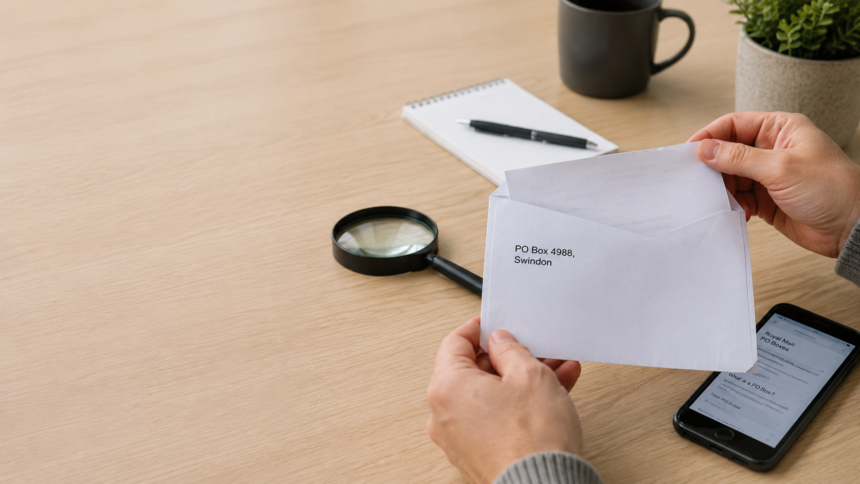
Receiving an unexpected letter with PO Box 4988 Swindon printed on the envelope can leave you wondering who sent it and whether you need to respond. A PO Box is a postal address used to receive correspondence without displaying the recipient’s normal street address. That alone does not identify the organisation behind a particular letter. The safest approach is to examine the contents, identify the company or authority named inside, and verify its contact details independently. This guide explains what the address tells you, what it does not tell you, and how to handle unfamiliar correspondence without exposing personal or financial information.
What Is PO Box 4988 Swindon?
PO Box 4988 Swindon is formatted as a UK Post Office Box address associated with the Swindon area. A PO Box is primarily a mail-handling service rather than the physical office where an organisation’s employees necessarily work.
Royal Mail offers PO Box services to individuals and businesses that want mail collected at a designated point or forwarded to another address. Businesses can also use them to maintain privacy and present a dedicated correspondence address.
That distinction matters when trying to trace a letter. Seeing a Swindon PO Box on the envelope does not necessarily mean the sender has its headquarters, branch office or customer-service team at that location.
| Detail | What It Tells You |
|---|---|
| Address type | UK PO Box mailing address |
| Location shown | Swindon |
| Main purpose | Receiving or processing postal correspondence |
| Physical office address? | Not necessarily |
| Does the box number alone prove the sender? | No |
| Best identification method | Check the organisation named in the letter and verify it independently |
Who Sends Letters From This Address?
There are conflicting claims on independent websites about the organisation associated with this particular box. No authoritative public source I found establishes a single current owner strongly enough to treat those claims as fact.
For that reason, the return address should not be used as the sole method of identifying a sender.
Instead, look inside the letter for several pieces of information that can establish where it came from:
- the full legal or trading name of the organisation;
- a company registration or regulatory number;
- a policy, account or case reference;
- an official website;
- telephone and postal contact information;
- details of the product, account or matter concerned.
A genuine business letter will usually contain more identifying information than the return address printed on the envelope.
Why Organisations Use PO Boxes for Correspondence
Large organisations can receive thousands of letters, forms and returned documents. A dedicated postal address provides a practical way of directing that mail into the correct administrative process.
Royal Mail specifically markets PO Boxes as a way for businesses to maintain a professional postal address while protecting the privacy of another address. Customers can choose services where mail is collected or delivered onward.
For organisations handling customer records, policies or accounts, a PO Box can also separate incoming correspondence from normal office deliveries.
This means the appearance of a PO Box on an envelope is not, by itself, suspicious. Equally, the presence of a genuine postal address does not prove that every letter displaying it is authentic.
What to Do After Receiving a Letter
Start by reading the complete document before taking action. Determine what the sender says the letter concerns and whether the information corresponds with any company, insurance policy, pension, investment, financial account or administrative matter you recognise.
Pay particular attention to deadlines. A letter asking you to update an address is different from one requesting immediate payment or confidential information.
Before calling any telephone number or visiting any website printed in an unexpected letter, search independently for the organisation’s official contact details. This is particularly important when money or sensitive personal information is involved.
If the correspondence names a financial services business, the Financial Conduct Authority provides a Firm Checker that allows consumers to confirm whether a firm is authorised or registered and whether it has permission to provide particular services. The FCA advises consumers to compare contact details with those shown in its official records rather than automatically trusting details supplied in unexpected communications.
What If the Letter Mentions Zurich?
Some web pages associate this Swindon mailing address with Zurich-related correspondence. Because an authoritative source confirming ownership of the specific box was not located, the association should not be treated as sufficient authentication.
If the letter itself identifies Zurich as the sender, use Zurich’s own website to contact the company rather than relying solely on a telephone number printed on unexpected correspondence.
Zurich’s official UK contact page provides separate contact routes for different products, including life insurance and pensions. For example, the company publishes dedicated customer-service information depending on the type of policy involved.
Give the official customer-service representative the reference number from your letter and ask whether the correspondence was issued by the company.
The same principle applies if another bank, insurer, pension provider or investment company is named: find its official website independently and verify the communication directly.
Signs That Deserve Extra Caution
Unexpected correspondence should receive additional scrutiny when it pressures you to act immediately or requests information unrelated to the apparent purpose of the letter.
Be cautious if you are asked to provide internet-banking passwords, transfer money to an unfamiliar account, disclose complete card details or send sensitive identification without first verifying who is requesting it.
The FCA warns that criminals can impersonate legitimate financial organisations and may contact consumers by post as well as by phone or electronic communication. It recommends checking firms independently and using authentic contact details rather than information supplied by someone whose identity has not been confirmed.
Spelling mistakes or unusual formatting may justify additional checks, but professional-looking branding is not proof of authenticity either. Logos and company names can be copied.
Should You Ignore the Letter?
Ignoring an unfamiliar letter simply because you do not recognise the return address is usually less useful than identifying what it concerns.
Read it, establish the claimed sender and check whether the account, policy, name, address or reference appears relevant to you. If the letter belongs to someone who no longer lives at your address, do not respond as though you are that person.
If it is addressed correctly but refers to an organisation you have never dealt with, contact that organisation through independently obtained details and ask why your information has been used.
Keep the original letter while checking it. References, dates and contact details can be useful if you need to raise a complaint or report suspicious activity later.
Can You Find the Owner of a PO Box From the Number?
A PO Box number should not be treated like a conventional business directory entry. Royal Mail’s public information explains how customers obtain and use PO Box services, while its Postcode Finder is intended for finding and checking postal addresses.
For someone receiving a letter, the most dependable evidence is usually contained in the correspondence itself.
The combination of a legal company name, regulatory details, account reference and independently confirmed contact information provides much stronger evidence than a return address alone.
How to Check Financial Correspondence Safely
If a letter concerns insurance, pensions, investments, loans or another regulated financial service, check the organisation through the FCA’s official tools.
The FCA says almost all UK financial firms must be authorised or registered and provides both the Firm Checker and a Warning List for unauthorised firms and individuals.
Compare the company name, Firm Reference Number and contact information shown in the official record with the details in your letter.
If they differ, stop before making payments or supplying confidential information. The FCA specifically advises consumers to use contact details obtained through its official checker when confirming whether a financial firm is genuine.
Frequently Asked Questions
Is PO Box 4988 Swindon a real postal-style address?
It follows the normal format of a UK PO Box address. Royal Mail provides PO Box services for receiving mail separately from a standard residential or business street address.
Does receiving a letter from this address mean it is a scam?
No. A PO Box is a normal postal service used by individuals and businesses. However, the address on an envelope should not be treated as proof that the contents are genuine.
Can I identify the sender from the PO Box number alone?
The safer method is to identify the organisation named inside the letter and confirm it through independent official contact details.
What should I do if the letter asks for payment?
Do not make a payment until you have independently confirmed the sender and the reason money is being requested. For regulated financial businesses, the FCA Firm Checker can help confirm whether the company is authorised.
What if the letter says it is from Zurich?
Check the relevant product and contact information through Zurich’s official UK website and ask the company to confirm the correspondence using the reference printed on the document.
Should I throw away a letter addressed to someone else?
Avoid acting on another person’s correspondence. If appropriate, unopened mail can normally be returned through the postal system with an indication that the named recipient no longer lives at the address.
Conclusion
PO Box 4988 Swindon should be understood primarily as a postal return or correspondence address, not as definitive proof of the organisation that sent a particular letter. If you receive unexpected mail carrying it, identify the business or authority named inside and confirm the communication using independently sourced contact details. When financial services are involved, official FCA records provide an additional way to check whether a firm is authorised. Taking a few minutes to verify the sender is safer than either ignoring potentially important correspondence or trusting an unfamiliar letter without checking it first.